Which Kind of Star?
Has anyone ever wondered why we see the Milky Way start at one point on the horizon, arcs up and over, then to the other side of the horizon?
Think about this. The galaxy spirals around like a super-gigantic cyclone. There is a plane on which this cyclonic action takes places. Kind of like the surface to a hurricane. There is such a thing as the Galactic Ecliptical Plane. It is simply an imaginary plane that describes where the galaxy spiraling occurs.
Our stellar system also has what is called an Eccliptic. A plane that describes where the orbital planes of the planets are located. This is where we get Orbital Inclination. We use Earth’s orbital plane as the 0° Ecliptic. Thus, one can say the other planets Orbital Inclination is how far off from Earth’s Orbital Plane they are. For example, Mars and Jupiter have Orbital inclinations of 1.8° and 1.3° respectively.
We see the Milky Way askew in the sky because the ecliptic of our stellar system is about 75° tilted out of the galactic plane. If our ecliptic were equal to the galactic plane, us whom are removed from our Equator would always see the Milky Way at the horizon towards the north/south instead of up and over. Basically, as Sol moves through the galaxy, our orbits actually describe spirals about Sol’s path as it orbits the Galactic Center.
Earth’s Equator is also used to draw the Celestial Horizon, where stars will be above and below it in the sky.
Remember, drawn with finger. Black is the Galactic Eccliptical Plane, Blue Sol’s Eccliptic.

A Wild Tagent the above. Now let us look into the stars.
Some known FACTs about O and B class stars: O class stars live maybe 10 to 100 million years, almost in sync with their O0 to O9, B class about 200 million to 1 billion years. Too short a time span for life to develop. Earnestly, anyway. However, the greatest reason why O and B class stars will not have planets, let alone life, is their incredible “radiative power”. The O class star, even the O9s, will blast so much radiative power that their Stellar Winds actually push surrounding stars away from them. No planets. No life. Sorry.
I shall admit, it would be cool to have a species that evolved orbiting an O class star. Their visual capabilities would be far superior than us humans have. Their ability to withstand higher doses of radiation is another formidability. They could simply nuke Earth enough to wipe out us humans, then the Earth is theirs. They would never need to perform any ground action. Just nuke us from orbit. But, alas, no planets for such to form.
B class stars may not be as powerful as O class, but they still pump out huge amounts of radiative power, enough to completely disrupt any hope of planetary formation. With B class stars, hypothetically, there could be a “torus” (donut), starting at least 100AUs(?), of loads of asteroidal rocks. This is the material in the proplyd blown away by the initial detonation and later stellar winds of the B class star. Great for mining, but NEVER safe from the supernova O and B stars always end. Basically, the older the B star, the further away that torus of material will be. Indicative of when it may go supernova. You could sort of run the clock backwards.
NOTE: Celestia is great for a visual creation of a stellar system with your planet. It takes time to learn the definition coding of each object, but you can build your own stellar system. I have for Onaviu. Alas, it is too huge to upload. Even zipped it is over 100GB. I created HUGE texture files for each object in the Ëosalus system of which Etherlond belongs. Now I have to completely rewrite what I have written for story after discovering that Great Eclipse dead on the date I had planned on starting the story. Gotten lazy about that, but am encoding more scientific data. And I have to go back and completely remake the Calendarial System because, utilizing Celestia’s timespeeding, I have since found a 7-year, 13-year, and 19-year significant cyclic events. Things I never calculated for, but a program helped me see them. AAAAAAArghh... And players wonder why GMs get headaches so often.
Celestia View of Onaviu
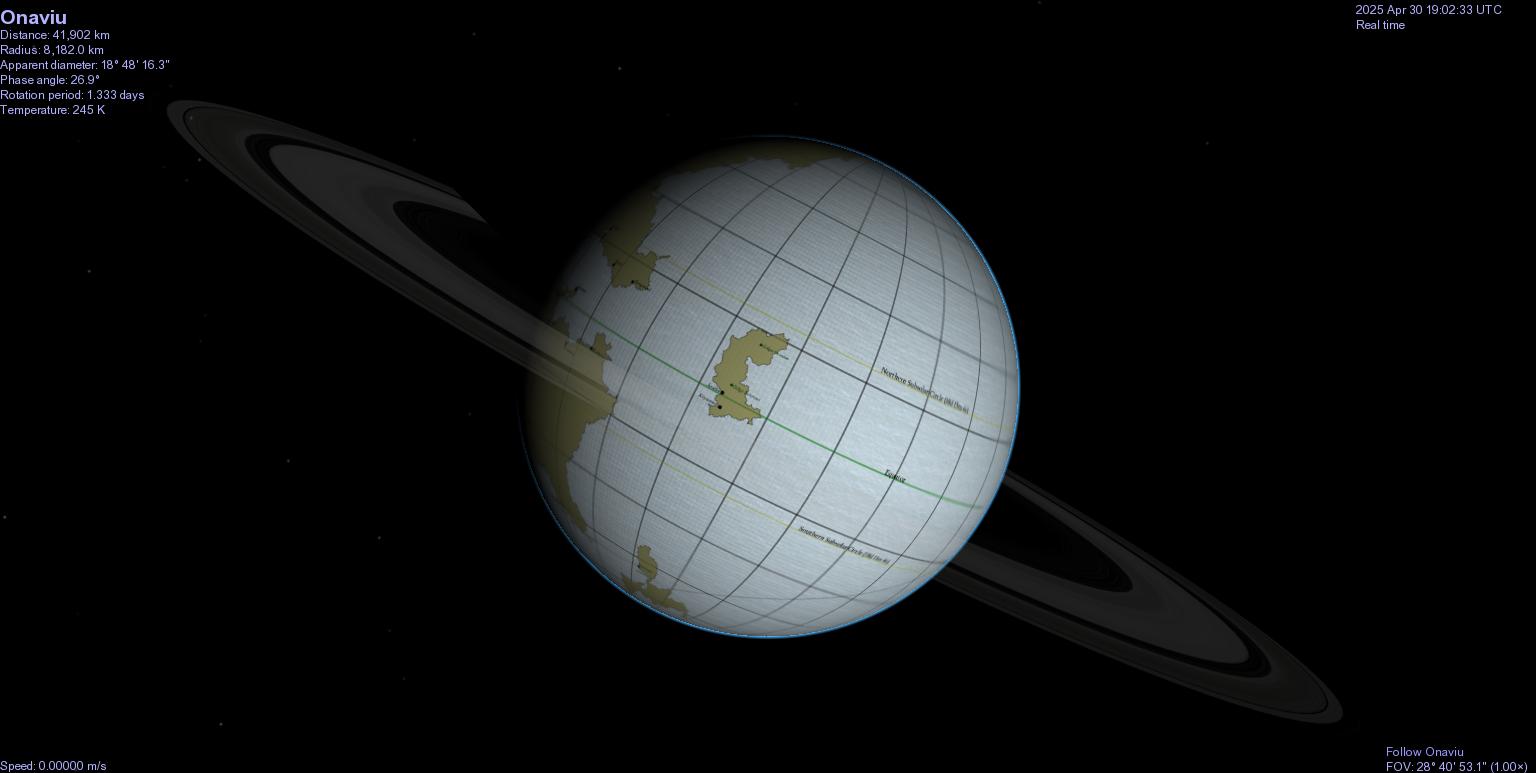
900px × 453px preview. R-Clk, open in new tab, or save image as.
An Eclipse on Onaviu by its moon Ondero

900px × 453px preview. R-Clk, open in new tab, or save image as.
A class stars would be the hottest any stellar system may form. However, A class stars still pump out large amounts of radiative power. For a planet to be Earth-like, it would have to phenomenally farther from the star, else it would be only a burnt cinder. A class stars live for maybe 0.5 to 5 billion years. Again, almost too short for advanced Life. Additionally, the terran world would also need to be increadibly more massive and denser than the Earth in order to hold enough atmosphere to filter enough Insolation even with a GMF. Also a large areal feature of water would also help Life. In other words, such a planet would need to be about 1.25-1.5g as Earth, maybe twice the distance with sun much smaller in the sky. A class stars are also thought to be the coldest stars that can supernova. Ooops...
Five billion years is enough time for us humans, why not other advanced life? Only to be snuffed out when the star goes supernova.
F class stars are considered the hottest stars where the development of Life may occur. But any Earth-like planet would need to be somewhat further away. This is where calculations of some brutal math come into play I ain’t covering. Such things as how much Irradiation the planet receives. Insolation comes into play after you have figured the atmospheric composition. How strong a GMF? O!, the brutality...
G class , Sol, our star. How much BRUTAL math do you think humans have done calculating the N-Body Problem of our stellar system? LOTS! How do you think we can get so accurate with our measurements? Yes, we may refer to Earth mass as 5.96e24 kilograms, but usually, that is accurate enough for our calculations.
A question to think about. Pi() comes into our calculations due spherical math. From Earth, we see the universe in a sphere, with Earth as the center point. Thus, Right Ascension and Declination. Or, my most favorite, the 360°2 method. Like Star Trek: Set course 127 Mark 48. How many decimal places of PI() would you need to define a point 13 billion LY away? Down to 1 meter resolution? T…H…I…N…K…
Wild Tangent: What is the difference between precision and accuracy? And, Why can neither be both?
K class stars are the coldest thought to be conducive for the development of Life.
M class stars are too unstable for life. They belch too often ;-). Additionally, any terran planet would have to be so close that it will be tidally locked with the star. No diurnalism except due to libration along the termination line. Even then, severely limited.
Interesting Note: Our best models show that once a star becomes a white dwarf, essentially a white-hot ball of iron kept solid by its own mass, will take about 20 to 25 Billion years to cool to a black cinder (my nomer). That is longer than the age of the observable universe. Thus, we humans may never find one to mine. Ever.
Then each class has a number rating with 0 hottest, 9 coldest within each class. Our star is a G2V. About 70+ years ago Sol was thought G3V. I seem to remember that it was even labelled a G5V. However, our accuracy now days shows it is a G2V star heading towards a G1V. We hypothesize Sol will only get as hot as a G0V, but never transition into the F class.
Then there is a size class for stars:
- 0 – hypergiants (!exist, my opinion)
- Ia – superluminous supergiants
- Iab – luminous supergiants
- Ib – subluminous supergiants
- II – bright giants
- III – giants
- IV – subgiants
- V – dwarf (formerly main sequence)
- VI – subdwarf
- VII – white dwarf
In mine ONLY opinion, hypergiants do not exist. How hypergiants are defined by the IAU puts their uppermost “size” at a point it is less dense than Earth’s uppermost atmosphere. Most hypergiants, when truly defined are actually nothing more than hyperactive Ia, Iab, Ib size stars. I NEVER include the “atmosphere” in the size of ANY celestial object. That is stupid. Mine opinion ONLY.
I Shall Always use DENSITY as my indicator for size of ANY celestial object. If I cannot slap it with my hand, it ain’t included in the Size Class. If you use Density as I use to determine a star’s true size, then even VY Canus Majoris is only a Iab size star. T…H…I…N…K…. Just an incredibly hyperactive star blowing off hellashus amounts of material. Yes, much larger, thicker photosphere, but that does not indicate size for ME. I do NOT include Earth’s atmosphere for its size. Now if I said ITs photosphere is 5Mkm, then that simply means it is hyperactively blowing trillions, quadrillions, perhaps yotatrillions, of tons of material every second. Probably blowing off more material in one second than Sol does in a lifetime.
Thus, I utterly refute the existence of any True hypergiant star. What you use for definition is your choice. But I am not going to include the part of VY Canis Majoris where its density is only 1 particle per cubic meter. WTH? And when I say “particle”, I mean a single atom.
I may not be a true Professional Celestial Mechanic, but I think my 50+ years of studies does account for something. As said above, as long as I am impervious to anything, everything, if I cannot slap it with my hand, it AIN’T NEVER going to be included. Only True Solid will I include. In Exempli: Should we consider the size of the Earth by VMR being 6371km Radius, or because we can measure its atmosphere that far out, is Earth 200,000km Radius in size? T…H…I…N…K… We have had probes that could measure Earth’s atmosphere out to about 3 particles per cubic meter. And as unbelievable as it may sound, Luna has an atmosphere. It is just far too tenuous.
The “atmosphere” MUST NEVER be included within the size classification of ANY celestial object.
MINE OPINION ONLY.
However you do it is up to you. Go with IAU and hypergiants exist. Go with my density-thingy, hypergiants do not exist. I shall be first to admit that hyperactive Ia, Iab, Ib size stars exist. Most are reclassified as Wolf-Rayet stars. Hell, get to be that supergiant and you shall be hyperactive. Would you not think so? Unless O class. Hell O class stars are hyper giants ranging 20+M⊕. We even found one O class star that may be over 90M⊕. When that thing detonates in a supernova, it will probably collapse a black hole. A singularity. The only 0-D realm. We have even found one O class star that is pushing away another F class star from a distance of 10+LY. That is an example of how much radiative power those O class stars have. No planets shall ever form around one. Probably sucked everything in and left no debris after detonating… And if any leftover debris, it would have LONG been blown away…
Comparison to Sol
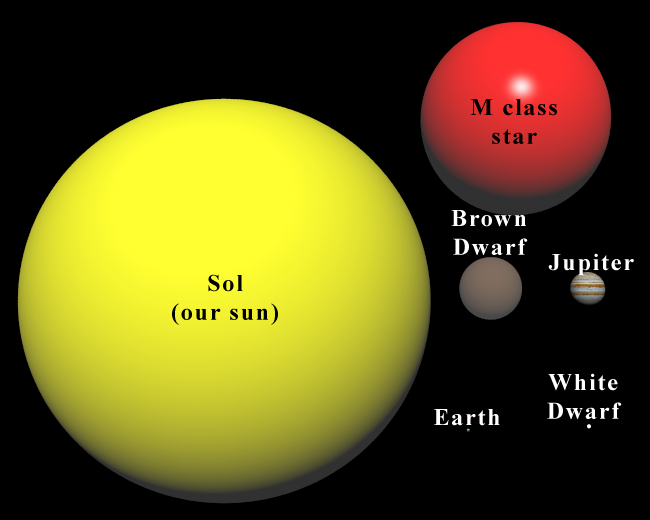
Main Sequence by Spectral Class
7734, just the O class Main Sequence averages a supergiant. Sol is the G class.
Size (Luminosity) Class
In image just above, the Main Sequence star ended up only one pixel when rendered this distance from CPnt. Actually all three were rendered that way. Just to get the Main Sequence star to appear as one pixel, I had to render the image at 2400 × 1800 pixels. Thus, resized to above, the Main Sequence star virtually disappears. But, if you look closely enough, you can see a faint 1px dot just to the left of the “M”. You may think it a dust speck on your screen.
A Calendarial Example
Etherlond
How about this for the newest world I created? This is how everything came out once I used that N-Body absolutely brutal math. Orbital Mechanics. Of course, this kind of feasibility depth is always dependent upon each and every individual GM(s). I can be said to go overboard sometimes. Sometimes such gives this:
- Hours, Minutes, Seconds equal as Earth. I like simplifying.
- 1 day = 26 hours
- 1 week = 6 days
- 1 month = 6 weeks
- 1 year = 11 months +4 days (???)
Why?, the +4 days? Etherlond’s Orbital Period is equal to 400 Etherlond days. Etherlond’s moon, Serenis, has a 36-day cycle. That only accounts for 396 days with 11 months. Then there are the +4 days.
As said, I DO love simplifying where I can. The above gives Etherlond an Orbital Period of 37,440,000 seconds. Earth’s is, being as exact as possible, 31,557,600 seconds. This makes Etherlond’s year equal to 433⅓ Earth solar days (433d 8h).
Well... That kind of screwed everything when I calculated everything out the best I could with the N-Body Problem. However, the Us Human Three (UHT, or FSS, Federated Survival Services; just FeSS up) simply devised a 9 year cycle in which the date of the New Moon shifts through the Caledarial Months as shown below. Highlights show how the New Moon cycles through for all 11 months during each particular year. It cycles the 1st on Offset 0, 5th on 1, 9th on 2, 13th on 3, 17th on 4, 21st on 5, 25th on 6, 29th on 7, and 33rd on 8. Then back to 0-1st.
| 01 | 2 | 3 | 4 | 15 | 6 |
| 7 | 8 | 29 | 10 | 11 | 12 |
| 313 | 14 | 15 | 16 | 417 | 18 |
| 19 | 20 | 521 | 22 | 23 | 24 |
| 625 | 26 | 27 | 28 | 729 | 30 |
| 31 | 32 | 833 | 34 | 35 | 36 |
The Ponderers of the UHT discovered this in year “1”, which is officially listed as “0” (zero). They devised an Offset, 0-8, to account for the shifting of the New Moon through a nine year cycle. (Offset) × 4 + 1 = date of the month for the New Moon for that year. For the Offset, simply modulus the year by 9. Example: 1633 % 9 = 4; 2798 % 9 = 8; 5382 % 9 = 0; etc.
Screwy. But what other method would you have devised? Maybe your world does not have any satellites. Thus, it may rotate faster. Say, 19 hours? That is messed up. Prime Number. I would rather have 20h for factors of 2 × 2 × 5. Plus, 20 is divisible by 4 and 5. Most animals, including humans, on Earth tend towards a diurnal cycle of sleep:wake ratio about ¼:¾ of a day. I prefer Time Periods to break down to factors of F ≤ 7, where F = the Prime Factors of 1, 2, 3, 5, 7. I do not like going > 8 with Prime Factors of another number. Of course, this ratio lengthens and shortens because of Earth’s Axial Tilt. Its Orbital Obliquity. The above is the average.
However on Onaviu, my first novel series world I am still writing on, there are three different cycles of 7y, 13y, and 19y. UGghh... And notice how each increases: +6. And, are Prime Numbers.
Thus, Etherlond dates may look: 1633o4.06.32.23, down to the hour. And since everything starts from a “0”, those numbers are actually +1 when considering its “Ordinal Value”. Just like “variable arrays” in programming. The 1st (ordinal) is always indexed 0. Both are correct, just the actual absolute starting point of our Official Datekeeping System. UHT decided to start the Official Datekeeping from a 0-point. Why not? It simplifies. In other words, our first Starting Point was 0o0.0.0.0. Then, 0o0.0.0.1 would mean into the second hour. That is a lowercase “o”. Short for Year Offset N.
Another monkey wrench thrown in for further complication, the calculations for Etherlond’s Orbital Period show that it is exactly, rounded to 7 sigdigits: 3,7440,000.000 000 002 161 131 seconds. This amounts to the need to add one second every 462,720,677 years. Wonder if I should start worrying about that…
Basically, how scientifically, or fantastically, feasible you make your world is your choice. I am just offering some science behind how I do things as a GM. In FACT, Etherlond began as a RPC (Role Playing Campaign). Now, I am thinking (and some little codification) of making it into a novel series. How about the Great Mystery?
The GREAT Mystery
Easily summarized in a listing:
- Us Human Three
- quad-limbed
- penta-digital
- bleeds red
- Etherlond Life (as far as known)
- hexi-limbed
- octo-digital
- bleeds blue
“Although we consume Etherlond life, UHT have YET to suffer any ill effects.” (emphasis by Avari Ponderer Scribes). And therein lies the Great Mystery.
Our earliest memories are from myths and legends of UHT awakening in a large cavern, finding our way out, then losing the cavern. Almost as if we had “self-thrown” ourselves out into this vicious and savage Jungle World. OR, someone waited for us to exit and shut the door. Hmm...
UHT have managed to take a liking to some of the smaller animals, and it actually seems as if they have adopted US as their pets. We do help protect them after all. And they give us love and companionship. Had one, which we call the Lepterix, that tried their damnedest to warn us about what we now call the “Locust Faeries”. Seems the Lepterix would go around killing as many as they could when we were not watching. Seems in the faerie stage, they ARE very beneficial in pollinating our orchards and crops. However, it went pupal and came out as an utterly voracious destroyer of vegetation. They ate anything, everything vegetation for about a month, growing from 3cm to over 30, mated, laid eggs, then died. Only to come back three years later as Locust Faeries. We have found many other such diametric creatures on this world.
Some even begin life as the most evilest, wickedest, meanest, and nastiest creature, but after some time, it becomes quite a boon. Sometimes hidden for decades. Even centuries. We currently have 284 years of Official Dated records. Scribes are now going backwards with a dating system that easily works backwards as forwards.
Starting Date for RPC: 1283o5 is the year. I ain’t gone no further.
I usually attempt to make my worlds as scientifically feasible as possible. Then I throw magic in somehow, someway. Even if I have to go off on a severe “Wild Tangent”. On Etherlond, seemingly, “magical” abilities seem to be species dependent. Nothing new. Many tales of such abilities in the many yarns us humans have written. The rhamahath have absolutely amazing abilities with rock, stone, earth. The UHT does not seem to have any “magical” abilities. Can never say they do not, but so far, nothing has come forth, excepting the Lianor.
Our great Avari Ponderers devised the engineering mechanization of our fortification technology utilizing the special abilities of the rhamahath. We even signed a treaty once THEY figured a method to communicate with us. And that only took them about 100 years. We cannot communicate to the rhamahath in their language since they use “tremor modulations” for superduperhyperfast communications. One rhamahath could communicate our COMPLETE Unabridged Dictionary of the English Language to another rhamahath in mere millseconds. They have since invented vibratory modulations to produce a vocal-like effect. KEWL! No?
Basically, they open their mouths and project the sound. However, they do not have the lip and tongue flapping like UHT. Thus, while speaking, theirs mouths stay open until finished.
The Great Mystery is something the UHT still struggles with answering.
- Were we taken from another world and put here?
- How?
- By, Whom?
- By, What?
- And, Why?
With the alliance with the rhamahath, which we nomered the Federated Survival Services, the FSS, we now have fortification technology to not only protect our cities, but also our farm and range lands. And we can do it quickly. First was the capital Tanlindon. Next, our inland river base Neleiri. Next, the Neleiri Mines complex.
How is that for science creating a fantasy world?
Almost forgot Lianor
A strange metallic liquid at ambient temperature, it can assume shapes of any form. Once a shape is formed, it seems impervious. Virtually indestructible. Even rhamahath have no effect on it in solid form, a shape. However, it seems they can influence its movement (Lianor is motile) while it is liquid. Perhaps a form of communication of the Lianor? Shapes? But it mostly forms rods, blades, stabbing weapons, throwing weapons. We took ⅓ of our Lianor and a volunteer Avari had it injected within her. Of all volunteers, she seemed to be chosen by the Lianor itself. What became, we know not. Yet. But she can be found wandering Neleiri, pondering her choice. Currently in charge of the arrival of the construction crews and supplies before leaving to assume the command of the Lianadost Mission.
Who’s she? She is Avari. One of the “Giants”. Her name is Saramanusashahegashothu (sah•rah•mah•noo•sah•shah•hee•gah•sho•thoo). WOW! What a name... Seems with the Giants, their name also tells their life story. Her nickname is Sara (sah•rah). NOT (sa•ruh). If you wish to be a bit more semi-formal, you can use Sarama. Or, call her, Commander. For she has also been given the “ultimate command” of the Lianadost Mission. Even her child has joined. AND, That child could be a PC. Sara is definitely NPC. However, do not expect any special treatment from her if you play her child as PC. Do not worry. She is over 100 Etherlond years old. The Lesser, nomered Altais, of the UHT only lives (avg) 70 Etherlond years. The Anur (middle) live about (avg) 150 years. The Avari, nicknamed the Giants, live for about 1200 years.
Sara has had a somewhat fascinating career. Her lastest exploit was taking down a Tyrondrix by herself with only an axe.
And with all formality, Commander Saramanusashahegashothu. Herafter, known only as Sara. Or Sarama. I might type either. I know: Spoilers. But you still do not know about the Harini. Hmm...
But the Avari is a very sad life. They only “come into season” for breeding only once every 100 Etherlond years. WTH? That sucks a big one. You live about 1200 years and only have eleven shots, at best, at making babies? Even the Altais can make babies once a year. For how many years? The Anur (avg) about one chance every three years, four AT MOST, which is very, very rare. Sometimes, even once every two years. But that is kind of rare. Yes. Much larger. Much more powerful with their strength. 7734!, Avari spears weigh a whopping 35 kilograms ( about 77 pounds). And they can throw them some 200, 300 meters. How many Altais do you think it would take to throw one? Would you believe one? The Avari have engineered Ballistas that can fire two of their spears at once, be reloaded, and fired again in about 10 seconds for one 2-member Altais team. With all those gears, mechanisms... T…H…I…N…K…
US Human Three
Genus: Alnara
| Species | Life | Base Height | Size Modifier | Weight × | |
| Altais | 70y | 71/65 inches | +0 B/F | ×1/×0.93 WMult | |
| Anur | 150y | 80/72 inches | +1 B/F | ×1.1/×1 WMult | |
| Avari | 1200y | 120/108 inches | +4 B/F | ×1.2/×1.1 WMult |
With, B/F = Build / Frame, pounds = ×0.453592 kg. The number before slash = male, after = female.
Equation: BH × ((Od100-50) ÷ 200 + 1), cube H in inches, ×0.00050687, ×(B/FMod ÷ 100 + 1), ×WM = weight in pounds, ×0.453592 for kilograms. Inches × 2.54 = centimeters (cm).
The above equation may not be fully correct, yet. I still have to look it over. I typed it from memory how I did it on a calculator. Thus, with my aging memory, it is not complete. If you also follow PEMDAS, the above is the best way I remembered it. Have I remembered entirely correct? We shall see...
AND. Saddest of all. The UHT cannot interbreed amongst the three. That does not say love cannot happen. Just know there shall never be any children. Sorry. Genus Species thingy. UHT is three separate species. Altais + Anur + Avari = the Triple A, AAA. If concantenate only uppercase. To rhamahath, we are Lesser, Middle, and Giants. LMG? The Genus name is Alnara (ahl•nah•ruh). I know I have not placed emphasis in the pronunciation/phonetic spelling (as poor as it is), but I am still working on it...
An Eclipse on Etherlond
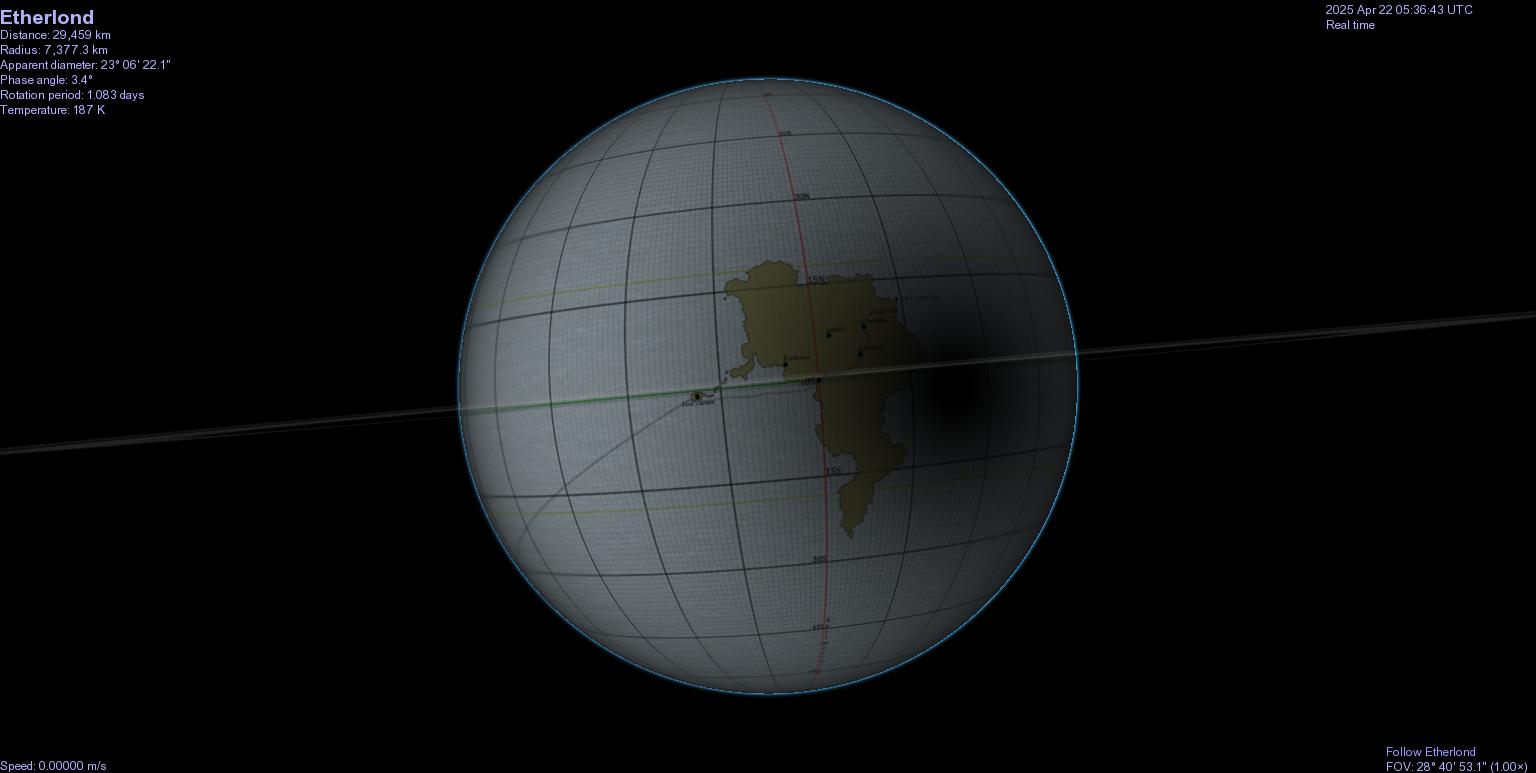
900px × 453px preview. R-Clk, open in new tab, or save image as.
An Eclipse on Onaviu
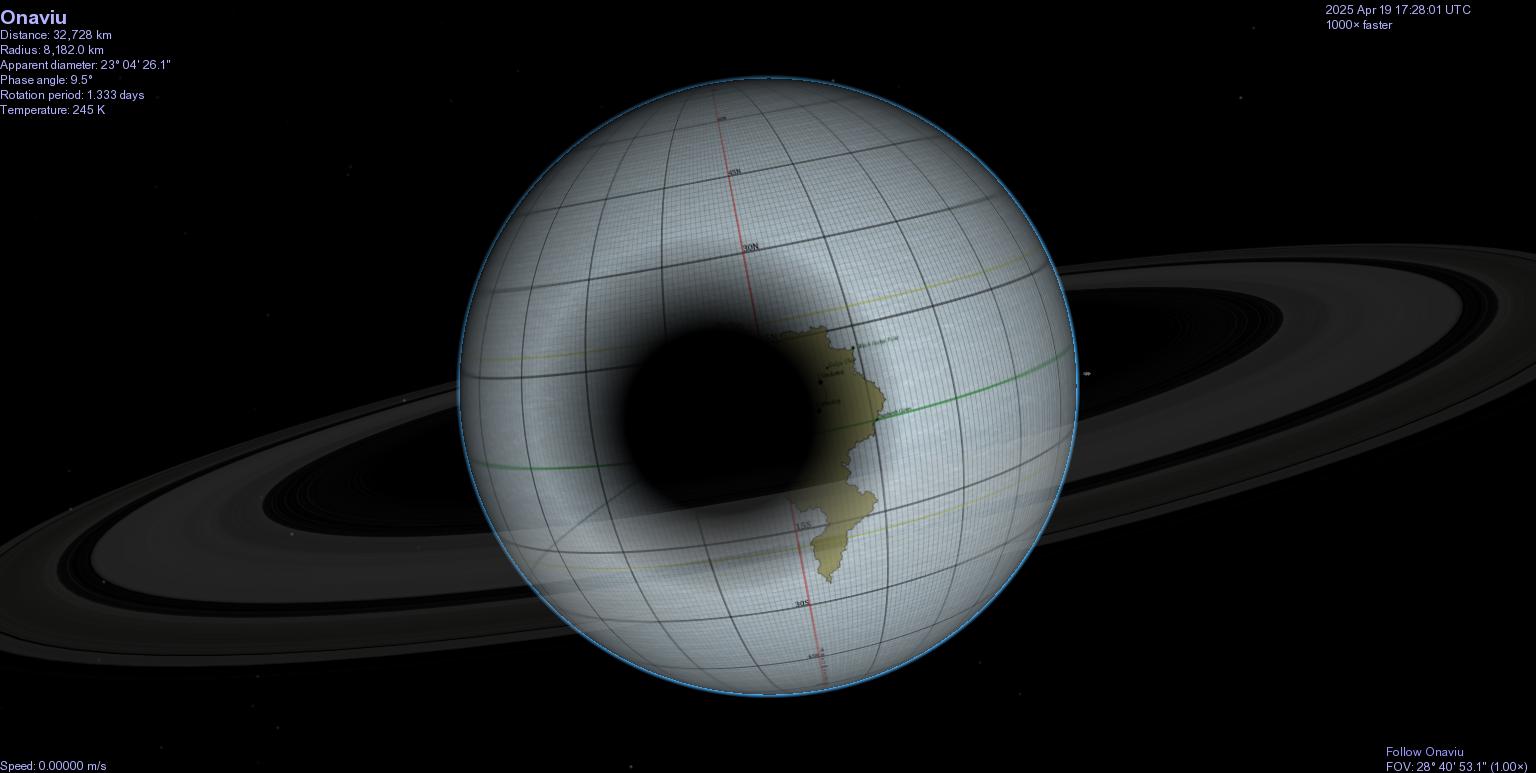
900px × 453px preview. R-Clk, open in new tab, or save image as.
I used my newer map for Onaviu for Etherlond so the size of the shadow can be seen as compared. The eclipses on Onaviu have a regular cycle with very little, if any, variation. Notice shadow is slightly northward? The next eclipse will be across the south polar region above 75°S latitude. The next will be like above image except slightly southward. And the last will be across the north polar region above 75°N latitude. Why? Because I am G.O.D. Gaming Operations Director and I made it that way. >:-P
And what is really funny, look at the UTC Date-Time Stamp. Did image captures on 20250430. April 19 and April 22. Yet both eclipses happened near the same landmass. L…O…O…K… Funny, No?
Here are some more thoughts I thunked.
The PURE Principles of Logic within Mathematics is irrefutable. They CANNOT be denied. “2 + 2 = 4” tells us FAR more than what it IS. It also tells us everything it AIN’T. Think...
If only everything can be that pure and provable.
More FACTs about O and B and A class stars. O class radiate light that is instantaneously blinding. May even burn the eyes out. B class stars a close second. A0 stars would be blinding, but A9 may not. Models tend to side with all A class stars being blinding. And when I refer to “blinding”, I mean according to human vision.
F class stars are brighter than Sol. But the slight increase in distance from the star may compensate. Especially for Terran-type “Earth”-like planets.
— The Unknown Atheist
Copyright © 2024 by RMFR. Licensed under CC-BY-NC-SA 4.0 International. All Other Rights Reserved