Some More Hows
Wild Tangent: 4.16 hours, or 250 minutes. The time it takes light to travel from Sol to Neptune. As said, Wild Tangent that popped into me frond just as I started this page. ADHD.
How Does a Terran Planet Differentiate?
Have you done the great gravity-viscosity experiment? Butter in freezer, 4 to 5 cm steel ball on top? This experiment is also indicative of geologic movement and time periods. IIRC, when I did this experiment some 50+y ago, it actually took a few months for my steel ball to sink ½way. This experiment is definitely NOT one if you wish immediate results. This experiment also shows the slow, methodical ways of the Scientific Method. As said, sometimes us scientists have to also be engineers, for we may need to invent new technology to falsify/verify our hypotheses.
Science is grueling. Science is boring. Science is absolutely stimulative. “Fascinating.”, as Mr. Spock would say.
The above experiment also shows how solids can convect. When the Earth was still a ball of molten magma, what was within it? Almost all elements on the Periodic Table. The most common are oxygen, iron, nickel, carbon, nitrogen, silicon, aluminium, calcium, magnesium, sodium, potassium, titanium, and Uranium, Thorium, Actinium as the only naturally occuring actinides. All other actinides are man-made. Iron being most dense, would percolate down to the gravitational centroidal point of attraction while molten. Ain’t it fascinating that the most common elements are also REQUIRED for ALL life? Does that not indicate and ideate the “inevitibility of abiogenesis”?
In a molten state, those elements can differentiate rather easily. Iron and nickel will sink towards the central point of gravitational attraction rather early and easily when everything is in a molten liquid form. However, a LOC/SIC formation is still some time off. Lighter elements will vary on how far they will sink, float, rise within the differentiating core layers. For example, The Lower Mantle may be loaded with copper, zinc, germanium, and the Rare Earth Metals in the Lanthanide series. They are denser. And in much smaller quantities than iron and nickel, would not get to the core due to suspension in situ. 7734, the Upper Mantle does not show signs of these denser metals needed for today’s technology. From samples of the oceanic crust and from the MOR, the Upper Mantle does have larger quantities of iron and magnesium. Thus, lava’s black coloring when bubbling up within the MORs. Basically, the darker (blacker) the laval material, the more basaltic it is, meaning the more iron it contains. Magnesium helps to turn the iron black. Thus, Iron Monger became Blacksmith. Being more dense than the silicate continental crust is what forces oceanic crust to dive in a ocean-land convergent zone. It has more iron, thus more density.
If you should ever find a “green” crystalline lava rock, keep it. It is peridotite. It comes from some 10-15-20±km deep within the Earth. Very valuable to volcanologists. If found on the surface, it was expulsed by a rather large volcanic eruption from very deep in the Earth. Chunks may get torn off and lifted out during these power-eruptions. Especially, the explosive rhylitic eruptions. We have found peridotite where we never expected to find any.
Even in a molten state, it still took about 3Ga, perhaps, for the Earth to differentiate a LOC and SIC of iron and begin generating a powerful enough GMF. As all those elements boil and bubble out of that magmatic state, the Earth would have an atmoshere: Hydrogen, Nitrogen, Oxygen, Fluorine, Chlorine, Argon, etc. With all that heat from the Earth, those gases will form more complex gases, even without volcanic emissions, such as water vapor, nitric oxide, etc. And all those gases emitted by volcanic eruption. For eventually there will be volcanos.
As said, Earth has a severe case of flatulance, 4.5Ga later, us humans are destroying the Diversification of Life “Earth” created. WE WERE LITERALLY FARTED INTO EXISTENCE. Just took time… >;-P
As said, we know denser compounds will sink to a “float” point. Or, they actually sink to the central point of gravitation. Lighter compounds will rise to their “float” point. That is why Earth’s continental crust is like 40-50% silicon; and the other half is about 70% aluminium, as bauxite ore. And since Earth is still hot enough to cause convection within its core layerings, it can still be considered to be in a “molten” state. Just not liquid (LOC), rather solid. Gravity and the pressure it generates is what keeps everything solid except where melting occurs. All heat is doing is causing the material to become more elastic, pushable, pullable, floatable, WHATEVERable. It is more pliable. Look at a forger. Why do they heat the metal to red, orange, yellow, or white hot? It makes the metal more pliable, thus easier to weld it all together into a single mass. Metallurgy. Especially Damascus Steel.
Early Earth Differentiation Visualized
(Artist Conception)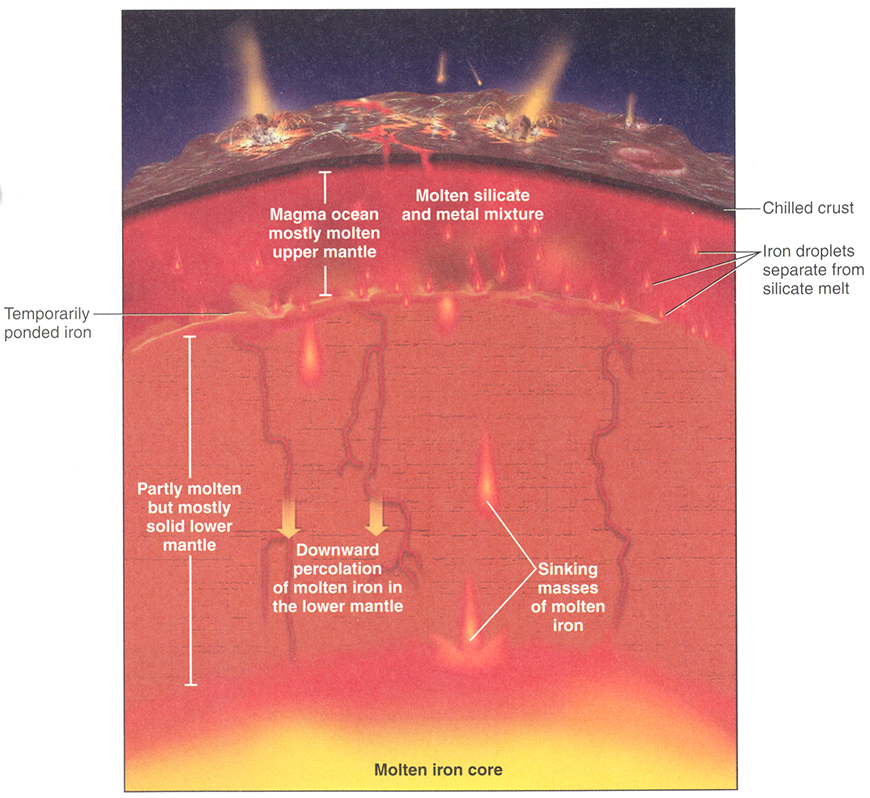
During this Hadean Period, I shall admit that the early crust did “float” on a magmatic ocean of material. Today? Wrong. The Earth is entirely solid except the LOC. As said, heat just makes the material more pliable, thus more convectable. And hotter, lighter material refracts and slows seismic waves more than colder, denser material. Even if entirely the SAME material. That is how we can map plates down in the Upper Mantle. We just study the seismographs as the earthquakes propagate through the Earth. Putting all that data from one seismic event together, then mapping out the fluctuations as the waves propogate.
How Do Terran Planets Form?
Many decades ago, 5, 6, 7, or near about, there was a computer program called ACCRETE. For some reason I want to think RAND Corporation created it. However, I can no longer find the original Fortran program. There are many, many 3rd party programs based on the original. Did you know the Fortran language still smokes all other programming languages when it comes to “pure computational calculations”? However, with today’s multi-processor machines running in the GHz, you can use any programming language today. Even give variables very long names. Now, it matters most on how many FLOPS. Well... Actually it always has.
Planets, just as the central mass becomes a star, planets also accrete in the protoplanetary disk (proplyd). Look at the image below.
Hubble Image of a Proplyd at HL Tau
1800px × 1800px; 249,856 bytes
Notice how the gravitational waves created by the formation of the central mass has generated rings and gaps within the proplyd. The central object and immediate two rings outwards are about 1.5× the size of our stellar system, out to Neptune. The outer material in rings and arcs, will probably become a combination of the Kuiper Belt and Oort Cloud objects. Basically, you are looking at what may have been our stellar system before Sol actually detonated into a star. Before any planets had fully formed. And if you look carefully, although not quite a proto-star, it is still generating stellar winds. Look for the spokes.
The cental mass has not detonated yet, but probably close. Remember, protostars are not as energetic as a mature star as our Sol. It also takes time for a star to differentiate and truly ignite its nuclear furnace. They are weaker with their Stellar Winds. Planets will actually form closer to the star and later scatter due to the gravitational dance of the N-Body Problem, and the outward push generated by the stellar winds.
For example, Neptune could have been the last planet, but it could have been as close as Jupiter is now, with the other seven progressively closer. As the Ice and Gas Giants got massive enough, they would pull the inner planets outwards, which in turn would cause the planets to scatter outwards as they are today in largely stable orbits. Again, the Mature Stellar System. Additionally, as the star matures, it applies greater stellar wind pressure upon the planets, helping to push them outwards. Thus goes the dance of the N-Body Problem. No stellar system can ever be said to be entirely stable. Only the 2-Body Problem can be. And most often are not.
The Asteroid Belt was probably created as gravitational tug-of-war broke it apart 3+Ga¿ ago. Maybe a combined gravtug from Venus-Earth-Mars then Jupiter-Saturn just pulled what may have become a planet. Then the tug-of-war smashed the pieces together until you have the sparse belt of rocks today. Jupiter stole some in its Trojan Points. The rest got scattered inward. Some may now be the NEOs.
7734. Earth may not have gotten to its current orbit but a billion years ago. This is why geologic ages use “annums”. Since the Earth was closer during its formation, its Orbital Period would have been shorter. However, evidence shows the diversification of life began in earnest about 800Ma ago. Thus, my hypothesis that Earth has been in its current orbit for at least 1Ga.
Mars, perhaps when as close as Earth, may have had a brief period where life may have formed. However, Mars did not have as powerful a GMF. Thus, Insolation irradiated the surface. Only water could provide enough filter for microbial life, but the atmosphere and hydrosphere would not have lasted long enough for anything other than microbial life. Additionally, I hypothesized decades ago that Mars was killed for other reasons. Just by the photos returned by Viking (???).
Venus, due to proximity, could not hold any gas lighter than carbon dioxide. The Insolation and Stellar Winds burned and blasted away lighter gases, making Venus the GrInf it is today. Earth, without its geomorphological replenishment of our atmosphere, would also be a GrInf. Kind of made this up with the Grinch in mind.
Mercury is the “lost cause” of our stellar system. It formed too close for the scattering to affect it, except to give it its current peculiar orbit. Eventually, Mercury will fall into Sol, leaving us with only seven planets. What then Pluto-fanatics? Make it a planet again so we have eight again? Get over it about Pluto. It has NOT cleared its orbital path, the very definition of planet. Plus its orbital inclination is too great to be anything other than a captured Kuiper Object with the help of Neptune. It may be what we term geomorphologically active, but it is still not a planet. It is a piece of junk from the Kuiper to Oort regions that got captured. Thus, Pluto’s wild orbital inclination and a 20 year period, out of its about 248 year OrbPrd, of being closer to Earth than Neptune.
And think on this about heat. What drives those super-sonic belts of winds on the Gas and Ice Giants? What drives those cyclones? Heat. From within. And those Gas and Ice Giants have a lot more heat than little ole Earth.
Large Impact Hypothesis
Also known as “TPK With Style” in RPG circles.
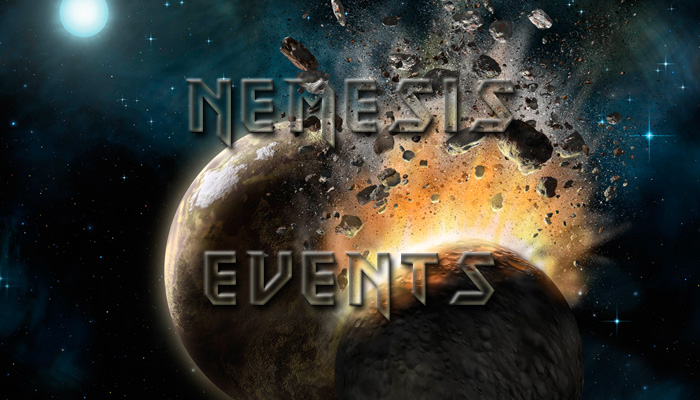
Just in case, TPK = Total Party Kill in RPG circles. ↟Thus, TPK with Style↟ Never know. The above image depicts both a Nemesis Event AND Large Impact Hypothesis. With those two objects, not even bacteria would survive. The above image also shows the beginning of a Global Sterilization Event (GSE). However, since the chemicals were already there, Life may reform quicker.
Our models have shown that if a GSE on a planet with life, say Earth, then Life may actually abiogenesize even faster since all the elements and compounds are already there. Just have to wait for the water to come crashing back down in a relatively short geologic time period.
See this simulation created by Discovery Channel: https://www.youtube.com/watch?v=PENT_hnyO-o
See all those crustal chunks flying away in Nemesis Events image above? Well they could very well form a moon later. Depends on enough material being expelled outside the Roche Limit. Luna, our moon, if caused by a large impactor, would have formed no closer than around 10,000km. IMS, Earth’s Roche Limit is about 10,000 km. Thus, most likely, the closest Luna ever was, was about 25,000km.
Luna, Earth’s moon, would have been ripped apart by tidal forces into a planetary ring which may or may not have still been there, if Luna developed within Earth’s Roche Limit. This is why Saturn has rings of more-or-less dust. One, or more, satellites got too close and were ripped to shreds. Rings can also form by accumulation of garbage about the planet’s orbital path. Instead, Luna probably formed about 25,000km away and has been thrown away ever since by gravitational and centrifigal and tidal forces. Luna receeds at about 3.8cm/yr? Or is it slower? Too lazy to look up. But I think it is closer to 4 than 2½ I have heard, or read.
And remember this. Just as the heat boils and bubbles out of the Earth unevenly, thus also does Luna’s recession. Luna has not receded evenly throughout its history, excepting recent times, last 1Ma. In fact, Luna at times may be pulled closer instead of receding.
Imagine the N-Body Problem alignment of Sol-Earth-Luna-Jupiter-Saturn. Would that alignment not cause further recession at that period of alignment? Then imagine the alignment goes Saturn-Jupiter-Sol-Luna-Earth. all those N-Body Problems SHALL cause uneven recession of the Earth-Luna system. It still occurs, just in more minute amounts. It is all about Gravity. The weakest, yet possibly the most universal, of the Four Fundamental Forces: gravity, weak, electromagnetism, strong; Listed weakest to strongest. And for gauge: weak force is about 1030× more powerful than gravity, IMS. The recession is fairly constant now due to a Mature Stellar System. Eventually, the Earth and Luna will tidally lock to each other and only one side of Earth will see Luna. And vice versa. We shall become a double-planet system orbiting about a common barycenter, instead of the current planet-moon system. That is a LONG time away. Don’t worry about it. But is interesting to know. For me at least.
Accumulation of rocks can be a conglomeration of boulders. A pebble pile. Rubble pile. Rocks loosely bonded and behaving as one single gravitationally attractive mass. These rubble piles are not uniformly solid, except each boulder, but are “cemented” together by gravity. Smaller impacts create dust and gravel and pebbles that further help to “glue” the boulders together.
Know what LaGrangian Points are?
LaGrange Points are points of gravitational neutralization. For each object, there are six L Points numbered L0-L5. The L0 point is mine own invention. I use it to indicate the central object of interest. True Lagrange Points are L1-L5. L4 and L5 are also called the Trojan Points of a planet’s orbit.
The Lagrange Points are points within an n-body problem that were once believed to be stable. In other words, something could be put there and would stay there. However, we have since found there are NO stable points within an object’s orbit. The n-body problem was made infamous with the 3-body problem. Now a Netflix series I feel is worth binging. At least twice, so you can cerebrate the second time.
Imagine this. Two masses begin forming in one orbit. One is the main mass, the other is at L4. Since this would violate the 3-body problem (Sol-Earth-Theia), the smaller less massive object will eventually get pulled into the larger more massive object. Scenario for the Large Impact Hypothesis. Very plausible, but still unprovable. Both objects are basically going to be of the same material. Such a huge impact would blast away much of the lighter material, while still retaining the denser material to form a LOC/SIC. Perhaps enough silicaceous material was thrown off and later formed Luna. I think I said this once before. But worth repeating.
Another viewpoint. Two Rubble piles at L5 and L0 could have been what set Earth off into a ball of molten magma. Then later attracted Theia.
The LIH is a very plausible explanation. To me, it IS the best model we have for Earth and Luna. We feel the two masses formed enough within the first 200Ma. They could have collided, even with both Hadean, and the impact would throw a lot of debris into orbit about the Earth. Earth swallows Theia, explaning Earth’s greater Overall Density, Larger Iron Content, and Larger Size. See image below, though.
Comparison of Onaviu to Earth
Would you believe that Onaviu contains slightly more than 2× the Volume of Earth? Both ARE to scale in above image measured from Center Points, not surface. Onaviu is around 2.118× the Volume of Earth. Additionally, is about 1.9Ga younger, thinner crustal plates which can be more easily manipulated by convection of heat within, has generated a GMF almost since inceptual formation, hotter climatologically (almost no polar Ice Caps), receives about 1.14× the Insolation of Earth, is currently going through another “great oxygenation event” (O2 levels will increase to about 31% in about 2Ma), and about 211kg more per m3 than Earth in Overall Density.
The above is why 3-D objects DO NOT work very well with 3-D comparison. Onaviu does NOT look like it has twice the volume of Earth. We see 2-D better when comparing things through size, such as dots of varying size, lines of differing length, etc.
Wild Tangent: Excepting Sol, did you know that Jupiter contains more mass and volume than all other objects in our stellar system combined?
Onaviu actually formed as the result of three masses forming at the L5, L0, and L4 points, coming together into a super-impact event. Three iron cores, three sets of varying silicaceous layering. LOTS of material to form a double planet. Well... what will much later become a double planet system. Onaviu’s main moon, Ondero, is actually even slightly denser than Onaviu in Overall Density. They are flinging each other apart, and in another 2Ga, they may be a Double Planet, instead of the current Planet-Moon System. As Earth and Luna, Onaviu and Ondero will tidally lock and only be seen from one side of each other. The current Eclipses by Ondero are WOW!
Eclipse Images from Celestia (https://celestiaproject.space/)
2 (3?) hours after first touch
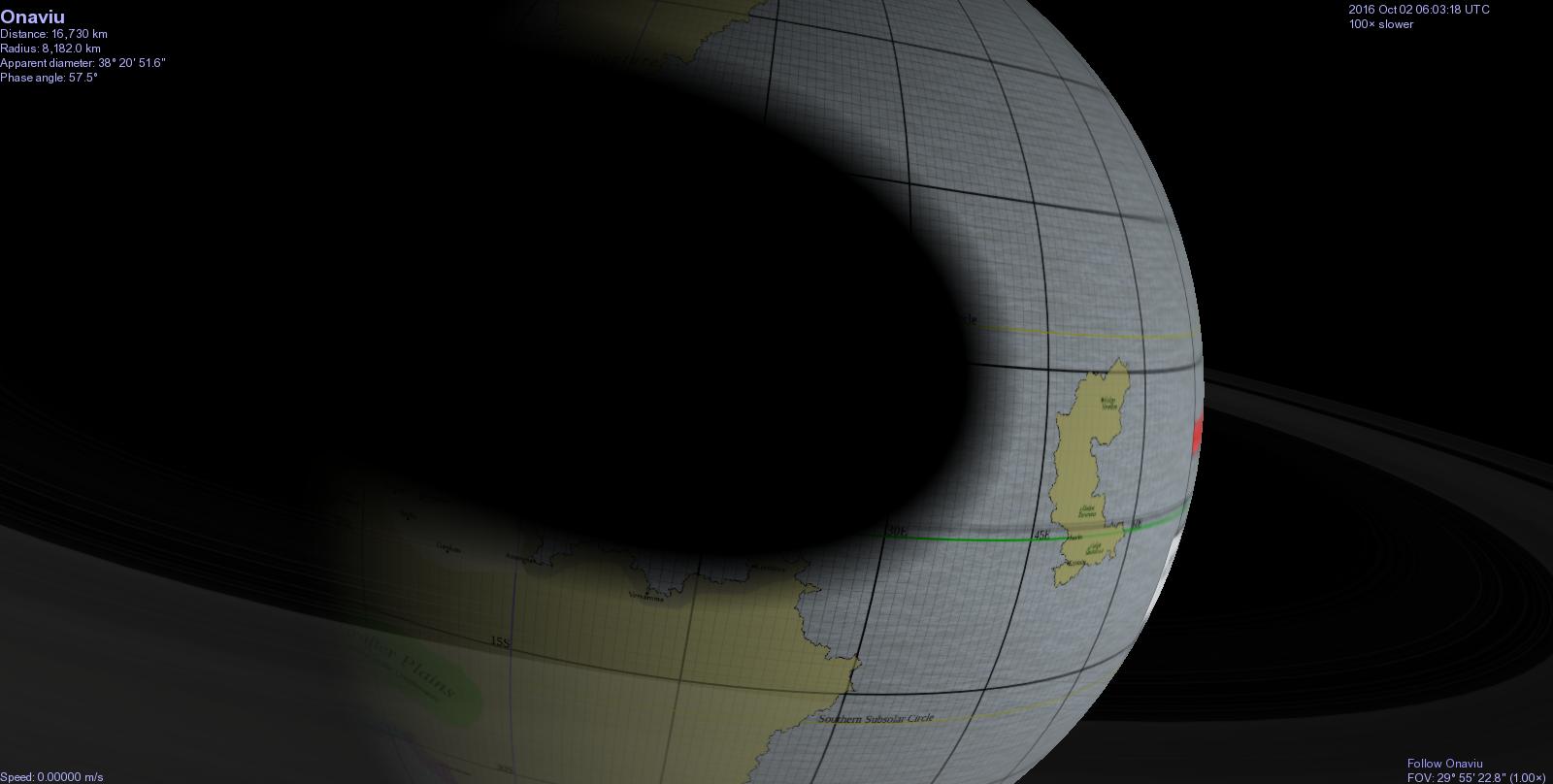
14 hours after first touch

32 hours hour after first touch
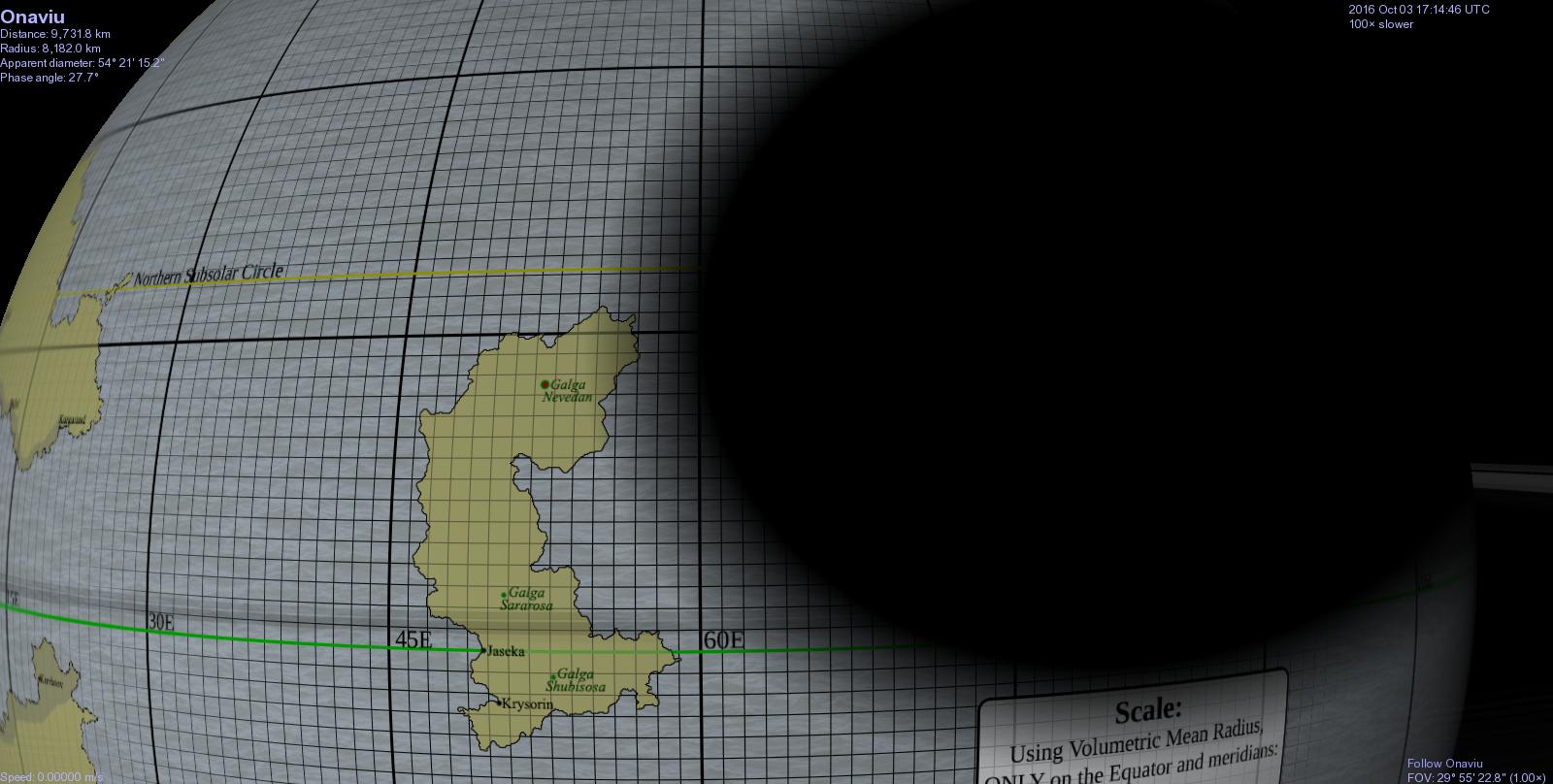
Onaviu actually rotates more than one rotation during the entire eclipse event. The whole event lasts between 42 to 43 hours. Longer than Onaviu’s Rotational Period, I know that much. Exact numbers not so much, but Onaviu rotates once every 28 hours. Thus, some parts of Onaviu get to see it on consecutive days. The map of Onaviu is a Platte-Carree projection projected onto an oblate spheroid. The only map projection that can be projected back onto a spheroid without further distortion, excepting polar pinch. The 2-D map is highly distorted at the poles. But the map above IS accurate on the spheroid, utilizing Onaviu’s Oblateness Factor and one point of tangency to create the Platte-Carree.
See all the work some GMs have to go through? Of course, entirely dependent upon depth.
The above eclipses and the orbit of Ondero adds further complications to the Calendarial System.
My newest world, Etherlond, is much less worse. Further calculations have shown Onaviu has a 7-year, 13-year, and 19-year cyclic events... And somehow, I have to get these incorporated into the story.
Waah.
— The Unknown Atheist
Copyright © 2024 by RMFR. Licensed under CC-BY-NC-SA 4.0 International. All Other Rights Reserved