Major Plate Tectonic Activity Forms
There are three, with subforms:
- Divergent
- Convergent
- Ocean to Ocean
- Ocean to Land
- Land to Land
- Transform
- Slipface*
- Opposed*
- Overthrust*
- Slipslide*
- others...
- Slipface*
*–Mine invention. How I reference them. I tend to think of Transform Faults as “slipface” or “strikeslip” faults. They slip and strike past each other, mostly.
Here are some images to save me thousands upon thousands of words...Continental Continental Convergence Zone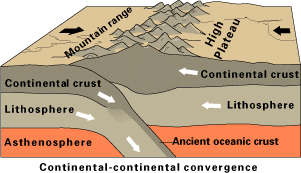
Ocean Continental Convergence Zone (notice red boils and bubbles)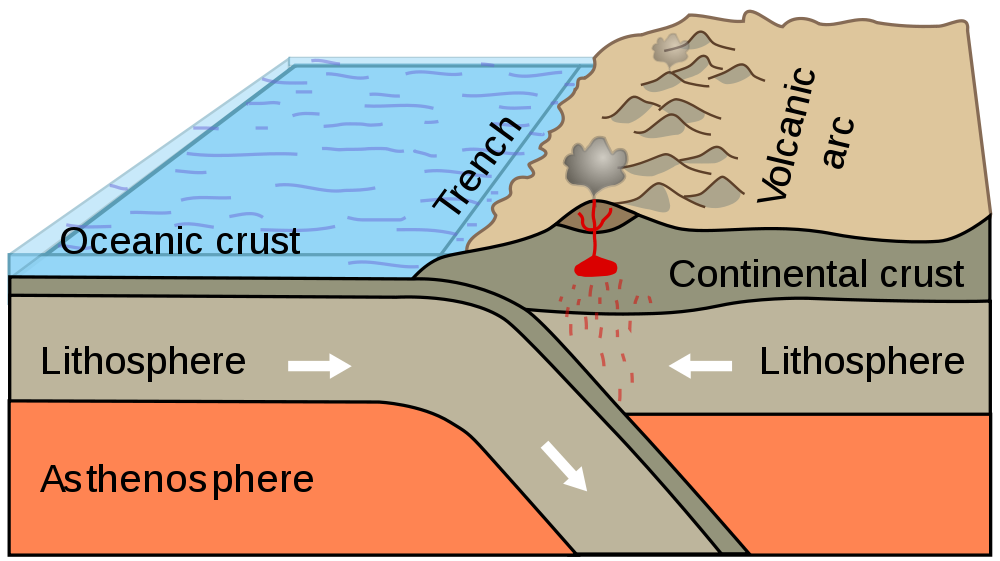
Oceanic Oceanic Convergence Zone
Oceanic Magnetic Striping Anomalies Formation Schema at Divergent Zones Visualized
Transform Faulting (red are the Transforms)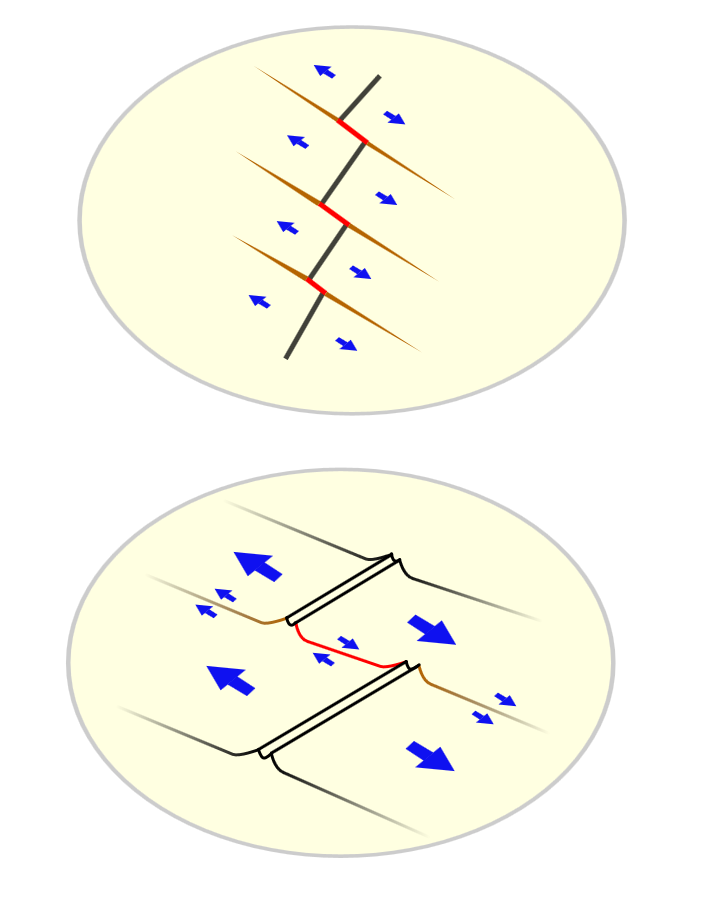
Topography of Portion of Atlantic MOR (Divergent)
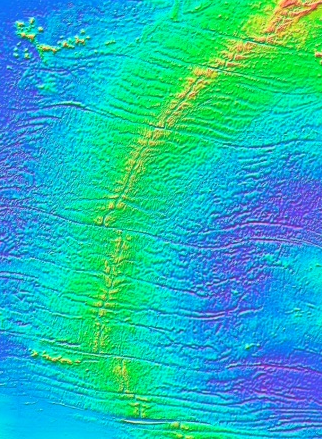
Notice all those Transforms due to uneven spreading. Proof heat radiates, conducts, convects unevenly.
Another way I remember these faults is: Divergent “spreads”, Convergent “smashes”, and Transforms “slide”. Easy Peasy.
Water, lots of it, makes plate tectonics inevitable on any terran planet as hot as the Earth. Water actually helps lubricate the plates, especially the oceanic plates. What is at the bottom of the oceans? Loads of “dust” from small animals and plants dying. Some having calcium carbonate shells. As that “dust” settles, just like SNOW, it accumulates, compacting it downwards. As it gets compacted, just like snow captures pockets of air, that dust on the ocean floor traps pockets of water. That “liquidy” rock causes lubrication as the oceanic plates slides under and down. That water eventually gets pressurized to a point it can no longer exist as water and causes melting along the uppermost side of the oceanic plate and continental (or oceanic) plate.
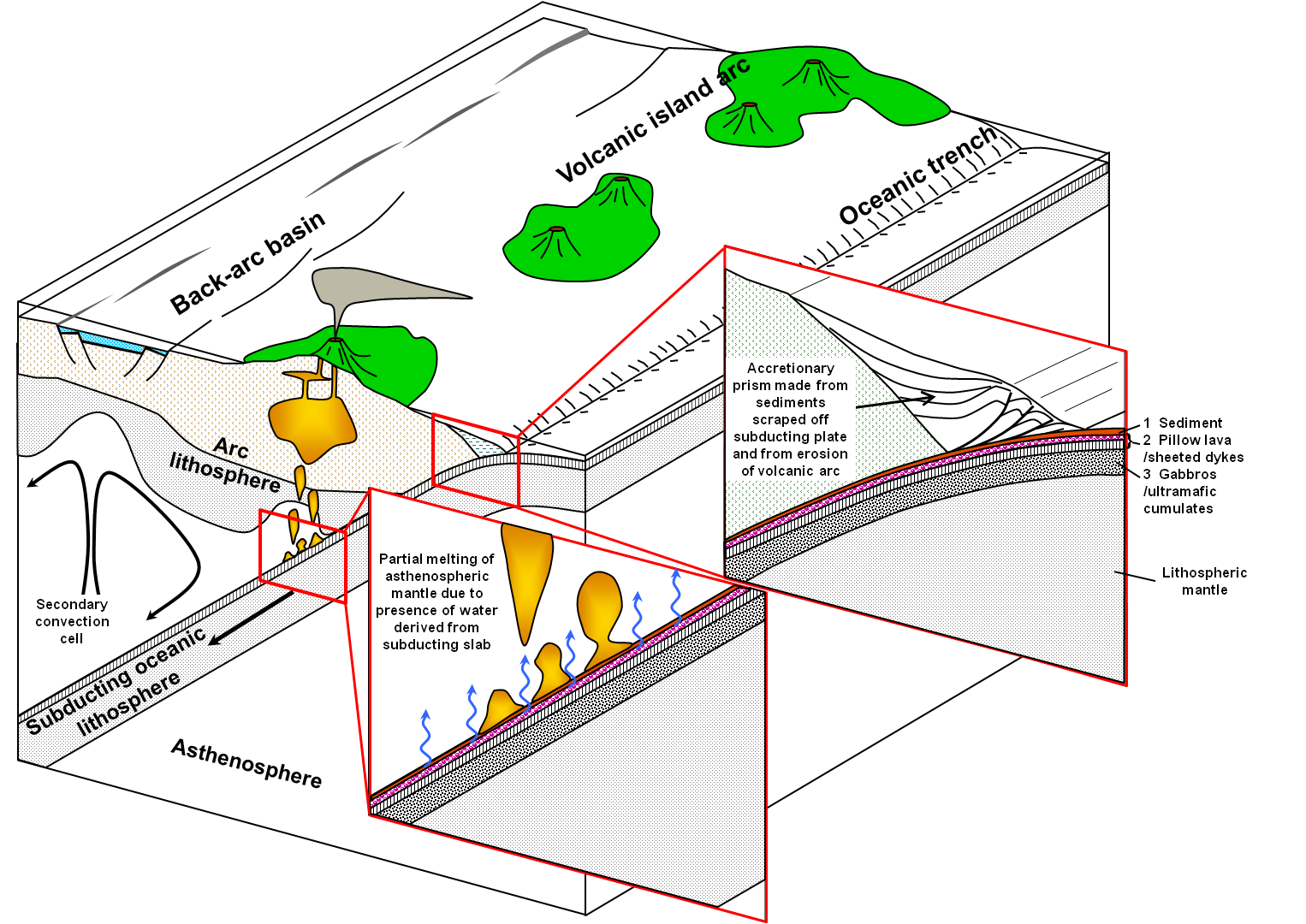
This form of melting is known hydrational melting, IIRC. The water and mineral containing layer begins melting because it cannot exist in a solid state under those temperatures and pressures. This begins melting other rock, and the “bubble” of melt will begin rising upwards due to decompression as the melt occurs. This is what created Mt St Helens way back in 1980. That small piece of the Farallon Plate, now known as the Juan de Fuca Plate still has a small Divergent Zone which creates melting deep inside and sometimes as much as 200km on the inland side of the continental plate, forming rhyolitic volcanos. Explosive volcanos.
On its upward trek to the surface, that melt-bubble will continuing mixing in less dense materials which already have water and gases literally dissolved inside the rock. This causes even more decompression melting as the melt-bubble rises upward. Once close enough to the surface, pressure builds due to gases being emitted from the magma. Eventually, the crustal layer above can no longer contain the pressure and BOOM! Explosive volcano extremely high in silicaceous material. Very little iron and magnesium. Thus, its whiter coloring. Any magma will be somewhat blacker, but will actually be more of a grey-whitish coloring.
Magma/lava Class by Composition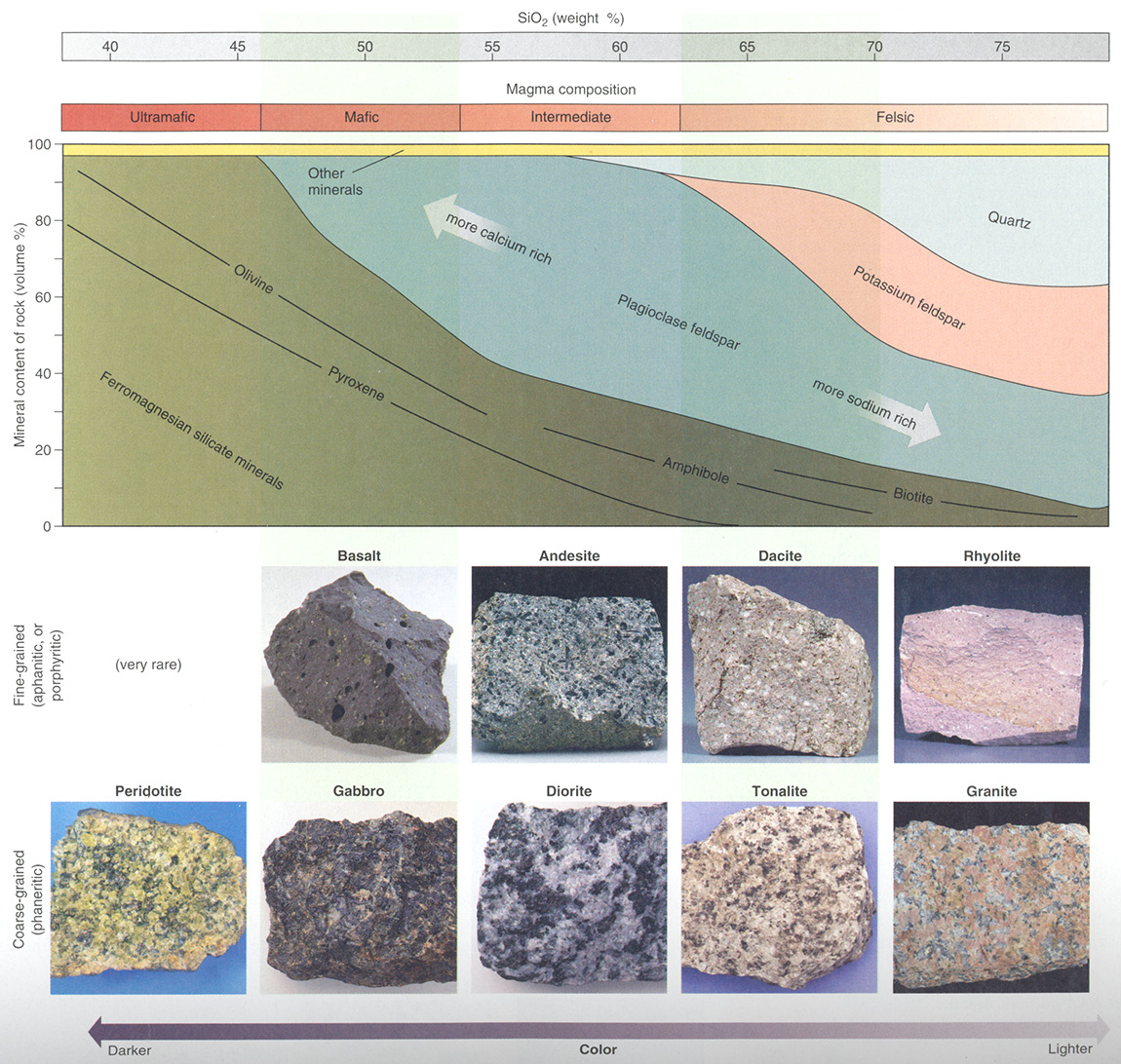
The top images are of lava. Bottom magma. What is the diference you may ask. Magma is what is underground within the Earth. It becomes lava when it flows on the surface.
Divergent Zones will always be spreading. There are no other subforms.
Convergent Zones have three subforms, Ocean to Ocean, Ocean to Land, and Land to Land. These three subforms can be directly opposed, smashing into each other. They can also occur if one plate is moving faster than another plate in the same direction. The Himalayan and Ural Mountains were caused by land to land collision. When ocean to ocean and ocean to land occurs, there will be an arc of volcanos some 100 to 300 kilometers inward on the overriding plate. Look at the chain of islands going from Japan to the Phillipines. Those are the resulting volcanos from the melt caused by the diving plate. Along the northeastern coast of the USA, the Juan de Fuca plate is still generating those Cascadian volcanos (Mt Ranier, Mt St Helens, et al.). Mt Ranier is considered to be the most dangerous of the Cascadian volcanos. If Mt Ranier blows like Mt St Helens did in 1980, the greatest danger will come from lahars from the glacial melt on the volcano. Seattle would get inundated with those lahars. Similar to flash floods caught in this video compilation. Except 100s of times larger and worse.
Transforms are like I classify them, they slide past one another, whether one side is faster, or they are opposed. Transform faults will always occur near Divergent Zones since the plates will be pulled apart at differing rates because heat radiates, conducts, and convects unevenly. Some parts of the DZ will spread faster than other parts, creating the transform faults.
There are many, many other forms of faults, thrust and depression flower faults, overthrust, strikeslip, crustal extension, etc., et al. Just have to do some research. Crustal extension is what created Valles Marineris on Mars.
— The Unknown Atheist
Copyright © 2024 by RMFR. Licensed under CC-BY-NC-SA 4.0 International. All Other Rights Reserved