A Supreme Hypothetical
The Aftermath of a Nemesis Event
What happened to Mars?
Was it shot?
Here is a hypothesis I played around with in some program I no longer remember which. It was over 30 years ago. Maybe 40.
I took a then best global DEM of Mars and colorized it with a color ramp. Came out crappy, but I did not feel like going through the brutal math of calculating a new color ramp. I no longer have that color ramp info. The DEM was then wrapped onto a spheriod. I used a long cylinder to show the possible path of the impactor.
The crude images below were created using some ray-tracing software on an ancient Posix system. Still runs, with Linux. And does some graphics faster than any Windows or Apple machine. Yet can be classified as “ancient”.
Highlighting of Hellas Depression (red)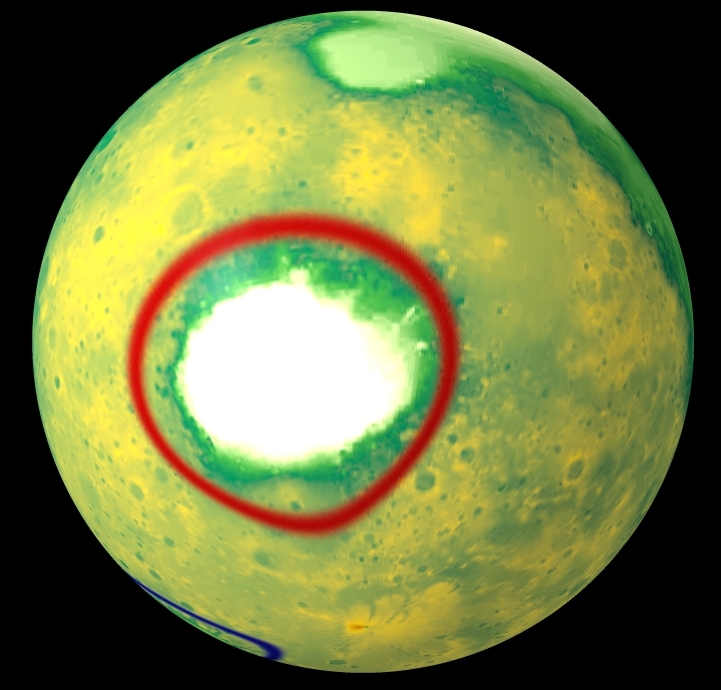
See how much more “circular” Helles appears when on a globe as compared to a 2-D map? (Below)
A cylinder representing the Impactor possible AoA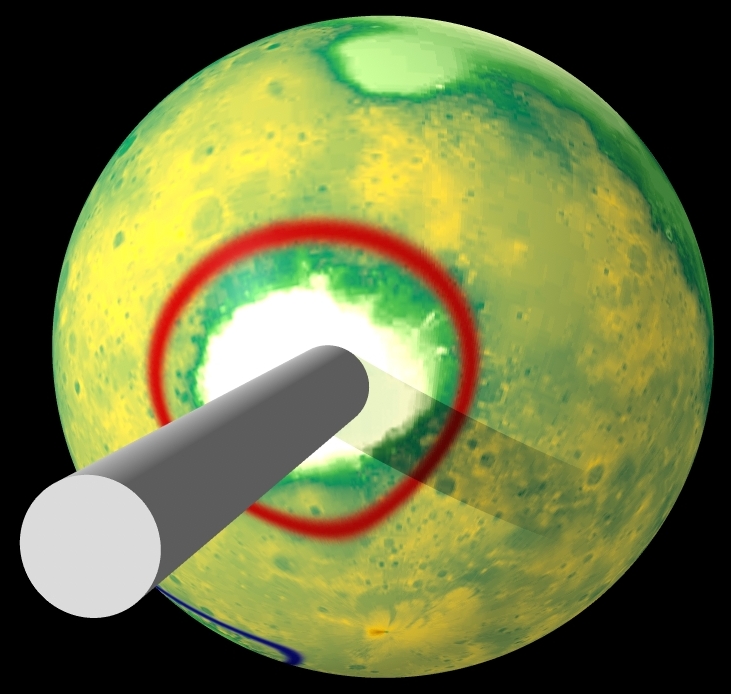
A view from a polar region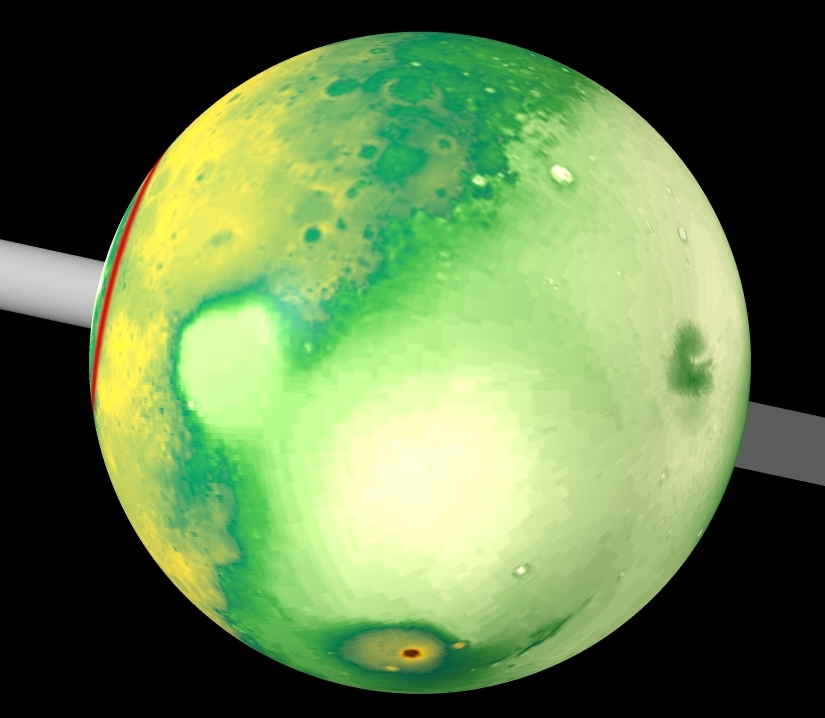
If Impactor went straight through.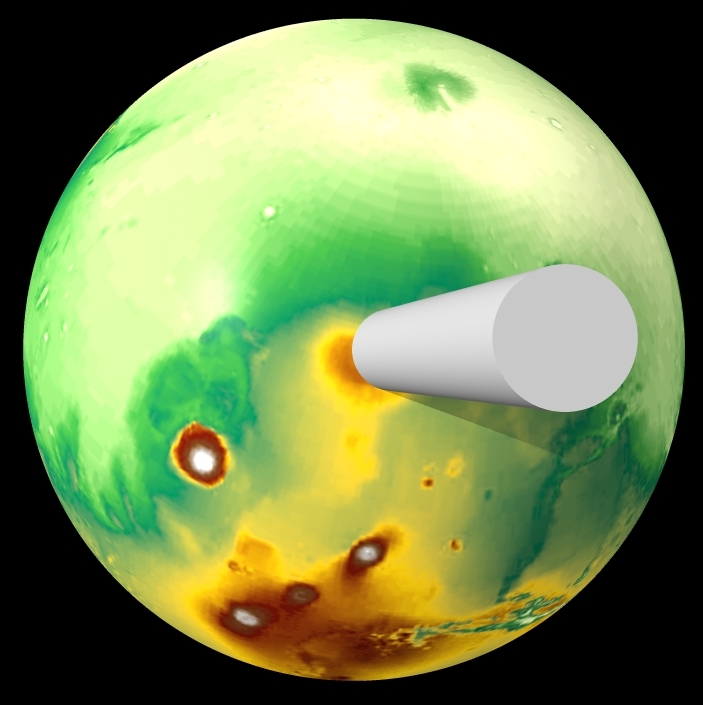
Southwestward from the cylinder, you see Olympus Mons. Southeastward from Mons are the 3 Tharsis Sisters. Running eastwards from Tharsis is the Valles Marineris.
My hypothetical is that Mars was hit with a super-sized Impactor, relative to Mars. That is what created the lowest spot known as Hellas Depression. Official name is Hellas Planitia. I hypothesize this occured Ga ago. Probably around 2Ga ago. The result of that impact can be seen on the almost opposite side of Mars. All that energy was deflected by Mars’s core to put a super-high-pressure system under Olympus Mons and the Tharsis Sisters. That impact all but blew apart Mars. The pressure and seismic energy would hit the core, be deflected, and come out in Olympus Mons and the Tharsis Sisters. The Valles Marineris canyon systems were created by the crustal layer being split apart from all that uplifting energy underneath.
Also remember that Helles Planitia had billions of years to “fill-in” from all the dust storms. Does not air, when sinking, tend to flow to lowest point? Just like water? Fluid Dynamics. Billions of years of dust blown into Helles, smoothing it over. We would have to create a colony on Mars with heavy machinery just to find out if this hypothesis of mine is false.
Here is another possibility within this hypothesis. The impact could have had enough energy that it may have actually shifted the core of Mars. Not permanently. This would have have created even more uplift on the opposing side of Mars. All of this would have happened in relatively short geological time periods. The sudden uplift, and ripping of crust would have sent any water flowing right out of Valles Marineris. Shortly after impact, within hours perhaps, the plasma fire would have completely incinerated the surface. Water and all. The stellar winds generated by Sol would have blown away most of this material. Perhaps enough water stayed gravitationally to refill the Helles region? Further smoothing the impact site until that ocean was ionized and blown away. Then more billions of years of dust infilling.
Plausible?
As said, we would have to doom people to Mars forever, just to find out. See? Some science questions are very high-risk to answer. Is it worth it to “know” that answer? Why? The best plausible explanation is a huge impact event. Just, T…H…I…N…K…
Remember, the above is a DEM, a digital elevation model with a color ramp. White is highest. Yellow to yellow-white (Hellas) is lowest.
And Mars never recovered. It is my hypothesis THAT ancient nemesis impact event wiped out any chance of Life on Mars. Gone. Probably 2-3Ga gone. 7734, the first thing that large of an impact would have done was completely blow away what atmosphere existed. Some may have been retained and Hellas may have became an ocean. Then later, a second impactor sealed the fate of any Life on Mars. See images further below. And there is a smaller shield volcano there on the diametrically dead opposite side of Mars. Probably a focusing of material as that energy went through Mars. A P-wave focusing perhaps. Would have been some hellashus P-waves to cause that. Damn.
Where I hail from (be a native of), we spelt it hellashus. We tended to pronounce hellacious like delicious. Does not sound as effective.
Perhaps the impactor did not hit at 90° as I assume. That could further cause the deflection of all that energy being deflected by Mars’s core. Kind of shows the iron is a rather small core. Less deflection.
However, if you were to map the latlong coordinates of the center points of Hellas Depression and the shield volacano northeastward of Olympus Mons. The center points literally map on the diametric opposite sides of Mars if you went straight down through the center and came straight out the opposite side. Go ahead and measure. See image I doctored showing this below.
See? I can cook up all kinds of crap just from science alone.
My Hypothesis is that Mars was blasted to 7734. The Hellas Depression is what remains of that impact crater. Probably 3Ga BP. Maybe water re-accumulated there for a very short time geologically. But most would have been blasted away by Sol’s stellar winds after the impact. Not as much water to fall back down. Shorter life span for any “basin” of water. Insolation would have irradiated the water into hydrogen and oxygen gas, and if Earth cannot gravitationally hold hydrogen and oxygen, what would make you think Mars could? Mars has probably been a DEAD planet for at least 2Ga. Enough dust storms during billions of years to bury evidence of Hellas being an impact sight. Then there is the second younger impact “westward” of Hellas.
Thus my simple question. What else is as plausible an explanation for the Hellas Depression being so deep and large and ellipsoidal? The production of Hotspot geology at Olympus Mons and the Tharsis Sisters? The ripping apart of the crust in that HUGE systems of canyons known as Valles Marineris?
What is your plausible explanation?
Hell, that same impact could have been responsible for a lot of the water channels we know see. The seismic waves would have been enormous all the way around Mars. Those seismic waves flushed, pushed the water out the original basins, splooshing it all over the place. Only to be lost that much quicker through Insolation irradiation. Now the only thing left is a very, very thin atmosphere of about 96% carbon dioxide. The heaviest gas Mars can hold, but in much lower density as Venus.
Those dust storms on Mars you see blowing people away is the biggest pile of horse hoowhee I have seen in Hollywood trying to do science. Mars’s atmosphere is so thin, a 20m/s wind (72kph; 44¾mph) would hardly be felt by a human on Mars. Yes, the dust would still blind, but the winds would hardly be felt. Just hook-up on a rope to stay together. O! and the sand blast effect? Negligible.
Hollywood attempting science. Hilarious. ROFLMAOWF
However, if the story fits, it can still be quite entertaining. I shall be the first to admit such. I enjoyed Armaggeddon, although the science was not quite correct. The concept of internal detonation analogied by the firecracker on the hand versus firecracker inside a fist is a very plausible method. However, the cost of such a venture would be astronomical. Qaudrillion$? Quintillion$? And how is it in such a movie the Conspiracy Theories of secret developments allows for us to JUST happen to have these Super-Shuttles? And the Armadillos? That is soo hilarious. Such a plan may very well be on the drawing board. It is a great plausible method for dealing with a Global Killer. Drill. Place a super-nuke at the correct depth, correct center point. Detonate. BOOM! The concussive shock wave of the nuke alone would blast it into many pieces. But into just two pieces? Probably convert it into a Shotgun Blast. However, as shown in the movie, such a powerful concussive shock blastwave would blow away much of the material left over. However, there would still be some Shotgun Blast effect, just not as bad. We could survive and rebuild. Perhaps without the greatest threat to all intelligent life: Religion.
That is the one thing to be thought of with very heavy cerebration. Conversion to a Shotgun Blast. Is it not better to detonate a series of nukes on the surface, nudging it away, from much further away? Remember: Equal, yet opposite. Be a 7734 of a lot less costly. More doable. Yes, we may have to deal with it again some time later... Or, it may disrupt another, flinging it our way. Lots of n-Body Problems that are virtually unsolvable. We can make short-term modelling, but that is still limited to at best a few millions of years. Maybe 30 at best? After that, PHFFT! We have to use something akin to “numerical theory” to actually be able to calculate that far. And even that sucks.
There IS no N-Body Solution for N ≥ 3.
And our stellar system has how many objects in the N-Body Problem?
It does not exist for the long-term astronomical time. Ga. Ta. Perhaps even as short as Ma. Depends on the star.
Remember, no matter how minute, gravity is still having an effect even from billions of LY away. It is so minute, that for local calculations, that effect can be ignored. However, is gravitys effect limitless? As recent developments in quantum mechanics suggest?
wild tangent: This would expain the Open Model. Gravity would take over and crunch everything back into a singularity. AND, in doing so, put a universe worth of energy back into a never ending loop of expansion–contraction. Must I do all the thinking? No violations. Like evolution. The Universe is trying ANY solution. This is the one we live in. Make the best of it. For, you shall not exist long enough to the next Iteration.
Some Other Images
MY Colorized DEM Platte-Carree Projection
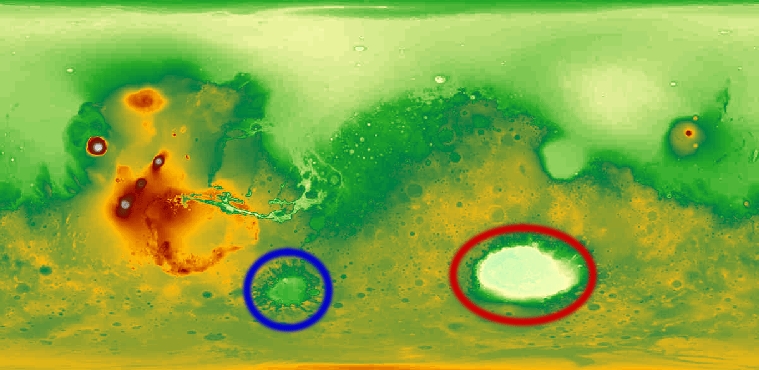
The other younger impact is highlighted blue. From above, see how much more “ellipsoidal” Helles appears?
Color Ramp above ranged golden-green-orange-red-white. The red ellipsoid defines the Hellas Depression. The blue highlights younger one, but still ancient. 7734. A triple shot that truly killed Mars. Did you not notice the smaller one somewhat NNE of Hellas? Could have happened in a staggered method, but Mars was killed by two shots from a Cosmic .38-Special.
An Other Colorized DEM Equirectangular Projection
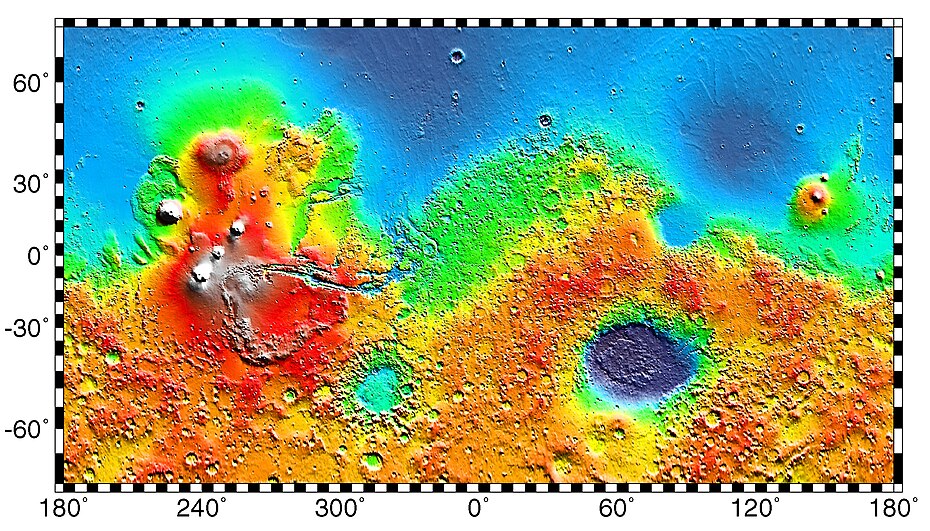
see the Helles Depression? ⇑⇑ (Official name is Helles Planitia)
Notice how deep Hellas is. And notice the reddish ring around Hellas. Result of large ejecta taking a short flight? And then the pressure of that impact almost blew out other side of Mars. Now, look at the latlongs along edges. Hellas is all but exactly 180° around Mars. And the latitudes are literally the same N and S. Diametric opposite sides of the spheroid of Mars. BOOM! An impact that sent shockwaves completely through and around Mars. Plausibly feasible?
Valles Marineris & Outflow Channels

All three are colorized DEMs. Original Size images in that Images/ thing. The other two Color Ramps ranged purple-blue-cyan-green-yellow-orange-red-white.
Each of the three images above are, respectively:
- 759px × 370px 214.77KB 24bpp JPG
- 930px × 531px 251.42KB 24bpp JPG
- 6655px × 2509px 26365.85KB 24bpp PNG
Y’awl have fun imagining those occurrences.
Notice LatLong Alignment

Two points of interest: the northernmost shield volcano and Hellas Depression.
- Shield Volcano
- ≅+40°
- ≅250°
- Hellas Depression
- ≅−40°
- ≅70°
Notice they are at the same latitude, one +, other -. And 250 - 70 = 180. Direct diametric opposite sides. That Cosmic .38-Special bullet may not have gone through Mars, but its effects did. The Tharsis region is a massive uplift as results. Deflected enough by Mars’s core. The Valles Marineris came from massive crustal extension. Additionally, any water there would have been spilled through the Valles Marineris. Geologically speaking, that Tharsis Uplift could have happened quite rapidly.
My Questions: What IS the geoidal model of Mars? Is Mars’s core still centroidal? If not, how offset?
— The Unknown Atheist
Copyright © 2024 by RMFR. Licensed under CC-BY-NC-SA 4.0 International. All Other Rights Reserved